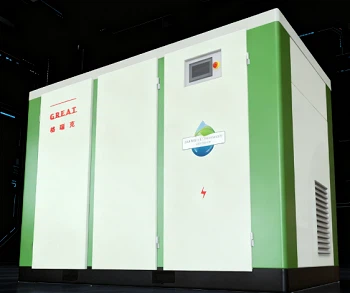
Hey there! As a supplier of Non Thermal Regeneration Adsorption Dryers, I've been diving deep into the nitty - gritty details of these machines. One question that keeps coming up is: How does the adsorbent particle size affect the performance of a Non Thermal Regeneration Adsorption Dryer? Let's break it down.
The Basics of Non Thermal Regeneration Adsorption Dryers
First off, for those who might not be super familiar, Non Thermal Regeneration Adsorption Dryers are crucial in industries where dry compressed air is a must. They work by using adsorbents to remove moisture from the compressed air. Unlike some other dryers like the Freezing Dryer, which cools the air to condense the moisture, Non Thermal Regeneration Adsorption Dryers rely on the adsorbent's ability to attract and hold water molecules.
Adsorbent Particle Size: What Does It Mean?
The adsorbent particle size refers to the physical size of the individual adsorbent materials used inside the dryer. These particles can range from really tiny to relatively large. Think of it like comparing grains of sand to pebbles. Each size has its own set of characteristics that can significantly impact the dryer's performance.
Impact on Adsorption Capacity
One of the most important aspects affected by particle size is the adsorption capacity. Smaller adsorbent particles generally have a larger surface area per unit volume. You can picture it as having more nooks and crannies for the water molecules to stick to. With a larger surface area, there are more sites available for adsorption, which means the dryer can potentially hold more moisture.
On the flip side, larger particles have a smaller surface area per unit volume. So, they might not be able to adsorb as much moisture as smaller particles. However, this doesn't mean larger particles are useless. In some cases, the flow characteristics of the compressed air through the dryer can be better with larger particles, which we'll talk about later.
Let's say you're running a manufacturing plant where you need a high - level of dry air consistently. If you use a dryer with smaller adsorbent particles, you're likely to get better adsorption capacity, which can lead to drier air. But you also need to consider other factors.
Pressure Drop
Pressure drop is another key factor influenced by adsorbent particle size. When compressed air flows through the dryer, it has to pass through the bed of adsorbent particles. Smaller particles create more resistance to the airflow because there are more of them and they're more closely packed. This increased resistance leads to a higher pressure drop.
A high pressure drop is not always a good thing. It means the compressor has to work harder to push the air through the dryer, which can increase energy consumption. In a large - scale industrial setting, this can translate into significant cost increases over time.
Larger adsorbent particles, on the other hand, offer less resistance to the airflow. So, the pressure drop is usually lower. This can result in energy savings, as the compressor doesn't have to work as hard. But again, we have to balance this with the lower adsorption capacity we mentioned earlier.
Mass Transfer Rate
The mass transfer rate is how quickly the water molecules move from the compressed air to the adsorbent particles. Smaller particles generally have a faster mass transfer rate. Since they have a larger surface area, the water molecules can reach the adsorption sites more quickly. This means the dryer can remove moisture from the air at a faster pace.
For applications where you need to quickly dry a large volume of compressed air, a dryer with smaller adsorbent particles might be the way to go. For example, in a food processing plant where you're using compressed air for packaging, you need to ensure the air is dry in a short amount of time to prevent spoilage.
Larger particles have a slower mass transfer rate because the water molecules have to travel farther to reach the adsorption sites. But if you're in a situation where you have a lower flow rate of compressed air and you're more concerned about energy efficiency, larger particles could be a better option.
Bed Stability
Bed stability is also affected by adsorbent particle size. Smaller particles are more likely to move around and get displaced within the dryer bed. This can lead to uneven adsorption and potentially reduce the overall effectiveness of the dryer. Over time, the movement of small particles can also cause channeling, where the compressed air finds the path of least resistance and bypasses some of the adsorbent material.
Larger particles are more stable and less likely to move around. They form a more solid bed, which ensures a more even distribution of the compressed air through the adsorbent. This can lead to more consistent adsorption and better overall performance.


Flow Distribution
The flow distribution of the compressed air through the dryer is crucial for optimal performance. Smaller adsorbent particles can cause uneven flow distribution due to their high resistance and tendency to move around. This can result in some areas of the dryer being over - utilized while others are under - utilized.
Larger particles, with their better flow characteristics, can provide a more uniform flow of compressed air through the dryer. This ensures that all parts of the adsorbent bed are effectively used for adsorption, leading to a more efficient drying process.
Practical Considerations for Choosing the Right Particle Size
When it comes to choosing the right adsorbent particle size for your Non Thermal Regeneration Adsorption Dryer, you need to consider your specific application. If you're in an industry where high - quality, extremely dry air is essential, like in the electronics manufacturing industry, smaller particles might be your best bet despite the higher pressure drop.
However, if you're more concerned about energy efficiency and have a lower demand for ultra - dry air, larger particles could be a better choice. For example, in a general - purpose workshop where the air doesn't need to be bone - dry, a dryer with larger adsorbent particles can save you money on energy costs.
We also offer other types of dryers like the Micro Heat Combined Dryer and the Micro Thermal Regeneration Adsorption Dryer, which might be more suitable depending on your requirements.
Conclusion
In conclusion, the adsorbent particle size has a profound impact on the performance of a Non Thermal Regeneration Adsorption Dryer. It affects adsorption capacity, pressure drop, mass transfer rate, bed stability, and flow distribution. There's no one - size - fits - all answer when it comes to choosing the right particle size. It all depends on your specific needs and requirements.
If you're in the market for a Non Thermal Regeneration Adsorption Dryer or have questions about how to optimize your existing dryer, don't hesitate to reach out. We're here to help you make the best decision for your business. Whether you need advice on particle size or want to learn more about our other dryers, we're just a message away. Let's start a conversation and find the perfect solution for your compressed air drying needs.
References
- Perry, R. H., & Green, D. W. (Eds.). (2008). Perry's Chemical Engineers' Handbook. McGraw - Hill.
- Walas, S. M. (1990). Phase Equilibria in Chemical Engineering. Butterworth - Heinemann.