


Hey there! As a supplier of Heatless Combined Dryers, I'm super stoked to chat with you about the types of adsorbents used in these awesome machines. Heatless Combined Dryers are a key part of compressed air treatment, and the adsorbents they use play a crucial role in getting that dry, clean air we all need.
First off, let's talk about what an adsorbent is. In simple terms, an adsorbent is a material that can attract and hold other substances on its surface. In the context of a Heatless Combined Dryer, adsorbents are used to remove moisture from compressed air. This is super important because moisture in compressed air can cause all sorts of problems, like corrosion in pipes, damage to pneumatic tools, and reduced efficiency of equipment.
One of the most commonly used adsorbents in Heatless Combined Dryers is activated alumina. Activated alumina is a porous, granular material that has a large surface area. This large surface area allows it to adsorb a significant amount of moisture. It's also very durable and can withstand high temperatures and pressures, which makes it a great choice for use in industrial applications.
Activated alumina works by attracting water molecules to its surface through a process called adsorption. The water molecules stick to the surface of the activated alumina, leaving the compressed air dry. Once the activated alumina is saturated with water, it needs to be regenerated. In a heatless combined dryer, this is done by using a small amount of dry compressed air to purge the moisture from the adsorbent. You can learn more about the process in our Non Thermal Regeneration Adsorption Dryer page.
Another popular adsorbent is silica gel. Silica gel is a synthetic, porous material that is made from sodium silicate. It's known for its high adsorption capacity and its ability to adsorb moisture over a wide range of temperatures and humidity levels. Silica gel is also very stable and doesn't react with most chemicals, which makes it suitable for use in a variety of applications.

Silica gel changes color as it adsorbs moisture. When it's dry, it's usually blue or orange, but as it becomes saturated with water, it turns pink or white. This color change makes it easy to tell when the silica gel needs to be regenerated. Just like activated alumina, silica gel in a heatless combined dryer is regenerated using dry compressed air.
Molecular sieves are also commonly used as adsorbents in heatless combined dryers. Molecular sieves are synthetic zeolites that have a very uniform pore structure. This allows them to selectively adsorb molecules based on their size and shape. For example, molecular sieves can be designed to adsorb only water molecules, while allowing other gases to pass through.
Molecular sieves are very effective at removing moisture from compressed air, even at very low dew points. They're also very resistant to chemical attack and can be regenerated at relatively low temperatures. This makes them a great choice for applications where very dry air is required, such as in the electronics and pharmaceutical industries.
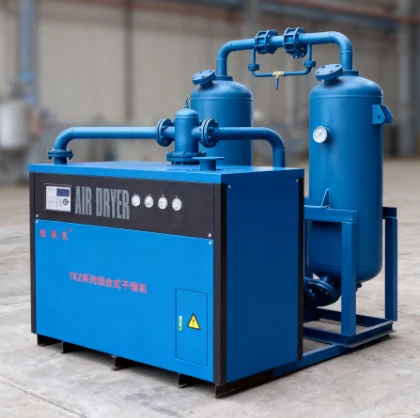
Now, let's talk a bit about how these adsorbents are used in a Heatless Combined Dryer. In a typical heatless combined dryer, there are two towers filled with adsorbent. While one tower is adsorbing moisture from the incoming compressed air, the other tower is being regenerated. This continuous process ensures that there is a constant supply of dry compressed air.
The choice of adsorbent depends on several factors, such as the required dew point, the flow rate of the compressed air, and the operating conditions. For example, if you need a very low dew point, molecular sieves might be the best choice. On the other hand, if you're looking for a more cost - effective option and don't need an extremely low dew point, activated alumina or silica gel could be a better fit.
Our Heatless Combined Dryer is designed to work with these different adsorbents to provide you with the best possible performance. We also offer a Micro Heat Combined Dryer which uses a combination of heat and pressure swing adsorption to achieve even better drying results.
If you're in the market for a heatless combined dryer or just want to learn more about the adsorbents used in them, we're here to help. Our team of experts can assist you in choosing the right adsorbent and dryer for your specific needs. Whether you're running a small workshop or a large industrial plant, we have the solution for you.
Don't hesitate to reach out to us if you have any questions or if you're interested in purchasing a heatless combined dryer. We're always happy to have a chat and discuss how we can help you get the most out of your compressed air system.
References:
- Perry, R. H., & Green, D. W. (Eds.). (1997). Perry's Chemical Engineers' Handbook. McGraw - Hill.
- Kohl, A. L., & Nielsen, R. B. (1997). Gas Purification. Gulf Publishing Company.


